On this page
- What is the powder metallurgy process?
- What materials are used in powder metallurgy?
- How does powder metallurgy compare to casting and machining?
- What are the design considerations and limitations of powder metallurgy?
- What are common applications of powder metallurgy parts?
- How is quality control performed in powder metallurgy?
- Key takeaways

What is the powder metallurgy process?#
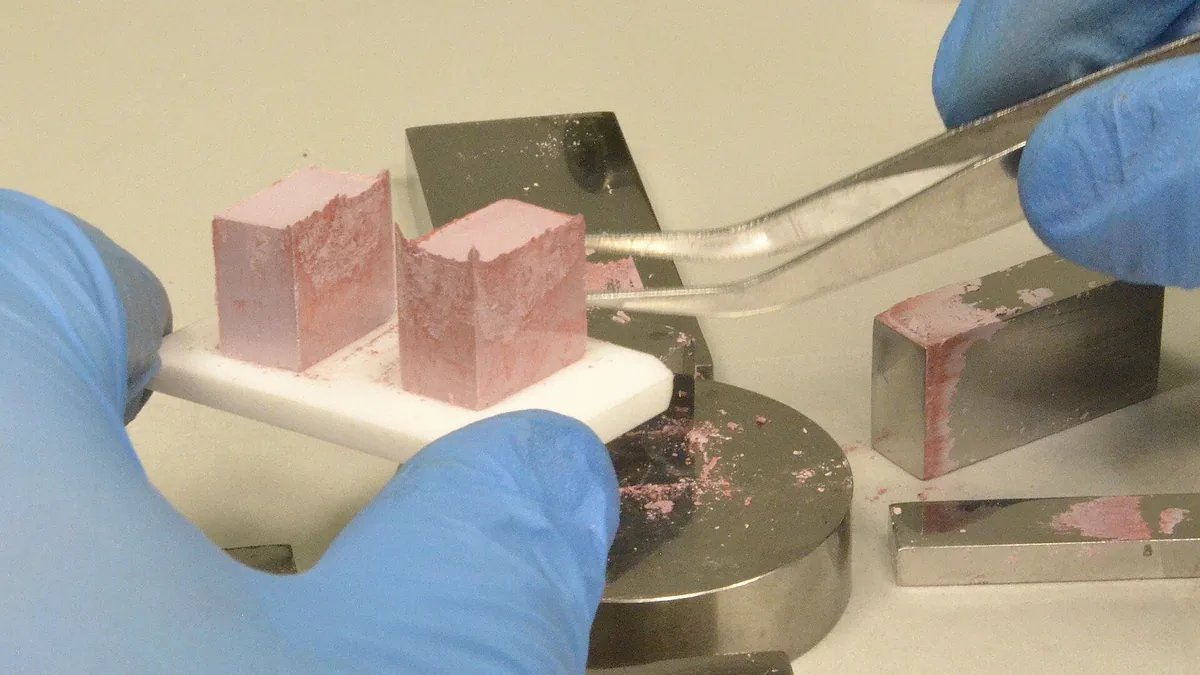
The powder metallurgy process converts metal powders into solid components through four essential stages: powder production, blending, compaction, and sintering. Metal powder is produced by atomization, blended with lubricants, compacted in a die at high pressure, and then sintered in a controlled-atmosphere furnace to bond particles without melting.
Powder Production#
Most PM powders are produced by atomization, where a stream of molten metal is disintegrated by high-pressure gas or water. Water atomization yields irregularly shaped particles that compact well, while gas atomization produces spherical powders preferred for high-packing density and flowability. Other methods include chemical reduction (common for iron powder from mill scale), electrolytic deposition, and mechanical milling. Particle size typically ranges from 10 to 500 µm, with the distribution tailored to the compaction and sintering behavior required.
Blending and Mixing#
Pure metal powders are rarely used alone. Blending combines different powders to achieve the target composition, while mixing incorporates lubricants (e.g., zinc stearate) to reduce die-wall friction during compaction. Homogeneity is critical: segregation can cause density variations and property scatter. Mixing is performed in double-cone or V-blenders, often under a protective atmosphere for reactive materials.
Compaction#
Blended powder is fed into a precision die and pressed at room temperature under pressures ranging from 100 to 800 MPa. The green compact gains strength through mechanical interlocking and cold welding of particles. Density after compaction typically reaches 70-90% of the theoretical solid density. Uniaxial pressing is the most common method, but isostatic pressing (cold or hot) is used for large or complex shapes. The green strength must be sufficient for handling and ejection without cracking.
Sintering#
Sintering transforms the fragile green compact into a structurally sound component. The parts are heated in a controlled-atmosphere furnace (e.g., cracked ammonia, nitrogen-hydrogen) to 70-90% of the metal’s melting point. Atomic diffusion forms necks between particles, densifying the compact and eliminating most of the porosity. For iron-based parts, sintering temperatures are typically 1120-1150 °C. The process can take 20-60 minutes, depending on part size and furnace design. Sintering atmosphere prevents oxidation and can also carburize or decarburize the surface if desired.
Secondary Operations#
Many PM parts are used as sintered, but secondary operations can enhance properties or add features. Sizing or coining improves dimensional accuracy by re-pressing. Infiltration with copper or a lower-melting alloy fills residual pores, increasing strength and enabling pressure-tight parts. Heat treatment, such as quenching and tempering, follows the same principles as for wrought steels; understanding the iron-carbon phase diagram helps predict the microstructural response. Steam treating creates a controlled oxide layer for corrosion resistance and surface hardness.
What materials are used in powder metallurgy?#
Powder metallurgy uses a range of materials, with iron and low-alloy steels dominating over 80% of structural parts. Copper and copper alloys, stainless steels, aluminum, titanium, and refractory metals are also processed, each selected for specific properties like strength, conductivity, corrosion resistance, or high-temperature performance.
Iron and Low-Alloy Steels#
Iron-based powders dominate PM production, accounting for over 80% of structural parts. Unalloyed iron gives moderate strength (UTS 200-350 MPa in the as-sintered state) with excellent compressibility. Adding graphite during blending allows in-situ alloying during sintering, producing steels with carbon contents up to 0.8%. Common alloying elements include copper (2-5% for strengthening), nickel (1-4% for toughness and hardenability), and molybdenum (0.5-1.5% for high-temperature strength). These low-alloy steels can reach ultimate tensile strengths above 1000 MPa after heat treatment. The iron-carbon system governs phase transformations; the iron-carbon phase diagram is essential for selecting sintering temperatures and post-sinter heat treatment cycles.
Copper and Copper Alloys#
Copper powders are valued for high electrical and thermal conductivity, corrosion resistance, and ductility. Pure copper PM parts are used for electrical contacts and thermal management components. Bronze (Cu-Sn) and brass (Cu-Zn) powders are widely employed for self-lubricating bearings, where controlled interconnected porosity retains oil. The sintering temperature for copper alloys is lower than for iron (750-950 °C), reducing energy costs. Copper infiltration of iron skeletons is a common technique to produce high-strength, pressure-tight parts.
Stainless Steels#
Stainless steel PM parts combine corrosion resistance with the design flexibility of the PM process. Austenitic grades (304L, 316L) are the most common, used for automotive exhaust components, medical instruments, and food-processing equipment. Ferritic and martensitic grades (e.g., 410, 430) offer magnetic properties and higher hardness. Sintering stainless steel requires precise atmosphere control, often using vacuum or hydrogen, to prevent chromium oxide formation and maintain corrosion resistance. The choice between austenitic and ferritic stainless steel in PM mirrors that of wrought alloys: austenitic types provide better ductility and corrosion resistance, while ferritic types offer higher thermal conductivity and lower cost.
Other Materials#
Aluminum PM is growing for lightweight automotive and aerospace applications, though the stable oxide layer on aluminum powder requires careful sintering atmosphere management. Titanium and its alloys are processed by PM to avoid the high cost of machining from wrought stock, using techniques like hot isostatic pressing (HIP). Refractory metals (tungsten, molybdenum) and cemented carbides (WC-Co) rely on liquid-phase sintering, where a binder phase melts and densifies the compact. Soft magnetic composites, made by coating iron powder with an insulating layer, are used in electromagnetic cores.
How does powder metallurgy compare to casting and machining?#
Powder metallurgy achieves over 95% material utilization, near-net shape with tolerances of ±0.05 mm, and high production rates up to 1000 parts per hour, outperforming casting and machining in material efficiency and cost for small, complex parts. It also enables engineered porosity for self-lubrication, which is impossible with wrought or cast methods.
| Aspect | Powder Metallurgy | Casting | Machining |
|---|---|---|---|
| Material utilization | >95% (near-net shape) | 60-80% (gates, risers) | 20-50% (chips from stock) |
| Dimensional tolerance | ±0.05 mm (as-sintered) | ±0.3-1.0 mm (sand casting) | ±0.01 mm (CNC) |
| Shape complexity | High for small parts; undercuts limited | Very high (complex cores) | High, but cost increases with complexity |
| Production rate | Up to 1000 parts/hour | Low to moderate | Low (single-part focus) |
| Setup/tooling cost | High die cost, low per-part cost | Moderate pattern cost | Low setup, high per-part cost |
| Porosity control | Engineered porosity possible | Generally dense, defects possible | Fully dense stock |
| Surface finish | 1-4 µm Ra | 3-12 µm Ra (sand cast) | 0.4-1.6 µm Ra |
| Material range | Limited to pressable powders | Nearly all castable alloys | All machinable metals |
Material efficiency#
The process converts over 95% of the starting powder into finished parts, compared with 40-60% for many machining operations. This is especially valuable for expensive alloys like stainless steel or cobalt-chrome.


Elimination of secondary operations#
PM parts often require no machining beyond deburring, reducing labor and cycle time. Complex features such as splines, gears, and cam profiles are formed directly in the die.
Controlled porosity#
Self-lubricating bearings with 15-30% interconnected porosity can be impregnated with oil, providing maintenance-free lubrication for the life of the part. This is impossible to achieve through casting or machining.
Consistent properties#
Automated pressing and sintering produce highly repeatable dimensions and mechanical properties, with fewer batch-to-batch variations than many casting processes.
Alloy flexibility#
PM can combine metals that are difficult to cast together, such as copper-infiltrated steel, or produce graded compositions within a single part.
What are the design considerations and limitations of powder metallurgy?#
Powder metallurgy design must account for part size limits, shape constraints from uniaxial pressing, residual porosity effects on mechanical properties, and high tooling costs that require large production volumes. Maximum part weight is typically under 2 kg, undercuts are not possible, and as-sintered densities of 85-92% of theoretical reduce ductility and fatigue life.
Part Size and Shape Constraints#
The maximum part size is limited by press tonnage (typically up to 5000 tons) and powder fill depth. Most PM parts weigh under 2 kg, though larger components are possible with isostatic pressing. Undercuts, cross-holes, and re-entrant angles cannot be formed by uniaxial pressing and require secondary machining. Aspect ratio (length-to-diameter) should generally stay below 5:1 to ensure uniform density distribution.
Density and Porosity Effects#
Residual porosity after sintering reduces tensile strength, ductility, and fatigue life compared to fully dense materials. As-sintered densities of 85-92% of theoretical are common for iron parts; higher densities (95-99%) require double-press/double-sinter or copper infiltration. Porosity also affects corrosion resistance, as interconnected pores can trap corrosive media. Designers must account for these effects when specifying PM components for structural or pressure-containing applications.
Tooling Costs#
Compaction dies and punches are made from hardened tool steel or carbide and can cost $10,000-$50,000 per set. This upfront investment makes PM economical only for production volumes above roughly 10,000-20,000 parts per year. For lower volumes, alternative processes like metal injection molding (MIM) or additive manufacturing may be more suitable.
What are common applications of powder metallurgy parts?#
Powder metallurgy components are found in nearly every industrial sector requiring small, precise, and cost-effective metal parts. Automotive transmission gears, self-lubricating bearings, surgical instruments, porous metal filters, and electrical contacts are common applications that leverage PM’s net-shape capability, controlled porosity, and material efficiency.
- Automotive: Transmission gears, synchronizer hubs, connecting rods, valve seat inserts, oil pump rotors, and sensor rings rely on PM for high-volume, net-shape production.
- Industrial equipment: Self-lubricating bearings, cam followers, sprockets, and hydraulic components use PM’s porosity and material efficiency.
- Aerospace and medical: Stainless steel and titanium PM parts include surgical instruments, orthodontic brackets, and lightweight brackets produced by HIP.
- Filters and porous media: Sintered porous metal filters from bronze, stainless steel, or nickel provide precise filtration for gases and liquids in chemical and food processing.
- Electrical and magnetic: Soft magnetic composites, electrical contacts, and heat sinks leverage copper and iron powder properties.
How is quality control performed in powder metallurgy?#
Quality control in powder metallurgy relies on density measurement, hardness testing, metallography, dimensional inspection, and mechanical testing to ensure consistent part properties. Key methods include Archimedes density measurement, Rockwell hardness testing, cross-sectional metallography, CMM dimensional checks, and tensile testing of bars pressed alongside production parts. Sintering atmosphere is monitored with dew point analyzers and oxygen probes.


- Density measurement: Archimedes method (weighing in air and water) or dimensional weighing determines sintered density, which correlates strongly with mechanical properties.
- Hardness testing: Macrohardness (Rockwell B or C) and microhardness check case depth after heat treatment.
- Metallography: Cross-sectioning reveals porosity distribution, phase constituents, and any contamination.
- Dimensional inspection: Coordinate measuring machines (CMM) or optical comparators verify tolerances. A detailed quality inspection checklist for metal parts covers the non-destructive and destructive tests applicable to PM.
- Mechanical testing: Tensile bars pressed alongside production parts provide ultimate tensile strength, yield strength, and elongation data.
Sintering atmosphere control is monitored continuously using dew point analyzers and oxygen probes to prevent decarburization or oxidation.
Key takeaways#
- Powder metallurgy is a near-net-shape process that compacts and sinters metal powders, achieving material utilization above 95% and tight tolerances without melting.
- The core steps are powder production (often by atomization), blending with lubricants, uniaxial compaction, and sintering in a controlled atmosphere.
- Iron-based alloys dominate, but copper, stainless steel, and specialty materials like titanium and tungsten are also processed.
- PM outperforms casting and machining in material efficiency, production rate for small parts, and the ability to engineer controlled porosity.
- Design limitations include maximum part size, simple die geometry (no undercuts), and high tooling costs that demand production volumes above 10,000 pieces.
- Density and residual porosity directly influence mechanical properties; secondary operations like infiltration or double-press/double-sinter can achieve near-full density.
- Quality control focuses on density, hardness, metallography, and dimensional checks, with atmosphere control critical during sintering.
- For iron-based PM parts, understanding the iron-carbon phase diagram and heat treatment response is essential for optimizing properties.